Mastering the Art of 3D Drawing Techniques
Ever drawn something, stood back, and wondered, "Why does it look so flat?" You're not alone. The difference between a flat sketch and a drawing that pops isn't magic or some innate talent—it's a simple trick that artists use to guide your eye. In the next few minutes, you'll learn the first and most fundamental secret to creating the illusion of space in art.
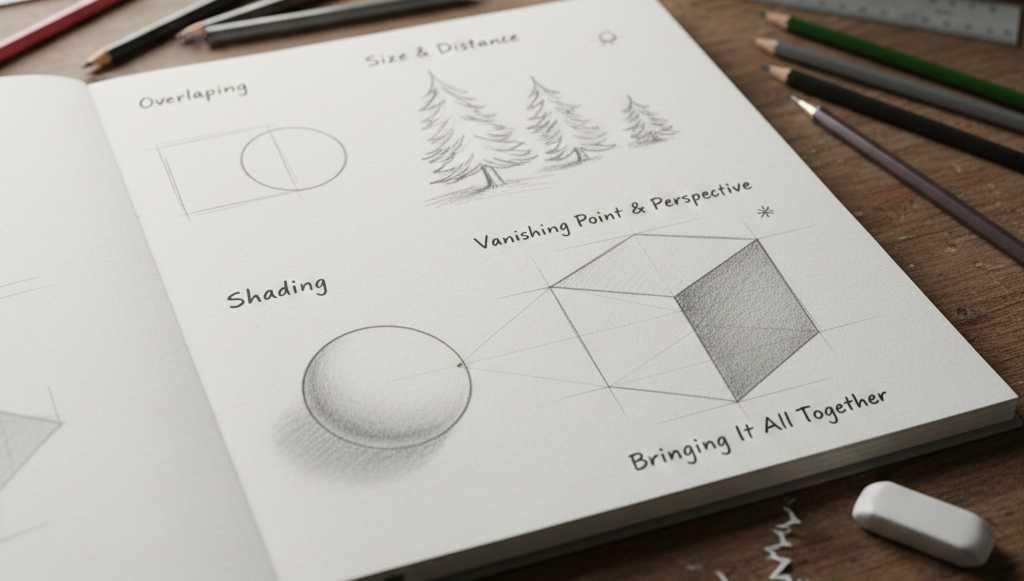
The fastest way to show depth is with a technique called overlapping. Grab a pencil and try this: draw a simple square. Now, draw a circle that is partially hidden behind that square, as if it were peeking out. Your brain automatically assumes the shape you can see completely (the square) is in front of the one that's partially hidden (the circle). Instantly, you have a "front" and a "back." Just like that, you've told a visual story with a clear sense of depth. This single principle is the foundation for learning how to add volume and form to sketches and is the first victory in easy 3D shape drawing. Simple, right? This one concept opens the door to a new way of seeing, and it's a tool you can use immediately to make your work feel more real.
How to Make Objects Look Farther Away (Without Any Math)
Beyond simply overlapping shapes, one of the most powerful tools for creating the illusion of space in art is something you already understand from daily life: size. Think about looking down a long road. The cars nearby look huge, but the ones way off in the distance are just tiny specks. Your brain automatically knows that smaller means farther away, and we can use that exact same trick in our drawings. This is a core secret for anyone learning how to draw 3D objects for beginners.
Let's try this with a quick sketch. On the left side of your paper, draw a simple pine tree. Now, on the right side of the page, draw another pine tree that's only half as tall and place it slightly higher up. Instantly, your drawing has a foreground (the big tree) and a background (the small one). Your brain fills in the gap, creating a sense of distance on the flat paper. It's a simple but incredibly effective technique.
To make this effect even more powerful, you can combine it with what you already know about overlapping. Try drawing a third tree that is even smaller than your second one, but position it so it is partially hidden behind that middle tree. This combination of shrinking size and strategic overlapping is a one-two punch for making your 2D page feel like a deep, 3D world.
Just by playing with how big or small you draw something, you've told a clear story about distance without using any complicated lines or perspective rules. You are now actively drawing 3 dimensional space. But what about making those flat-looking trees feel solid and round? For that, we need to stop thinking about outlines and start thinking about light.
From Flat Shapes to Solid Forms: Your First Lesson in Shading
You've learned how to create a sense of distance by overlapping shapes and changing their size, but the objects themselves might still look a bit like paper cutouts. The secret to making something feel solid and real isn't about drawing a better outline—it's about understanding light. Every object you see, from the apple on your desk to the moon in the sky, is only visible because of how light hits it. We can use this simple fact to bring our drawings to life.
To understand how this works, imagine a single lamp in a dark room. If you place a ball on a table, one side of it will be brightly lit, while the other side will be cast in shadow. This is the key difference between a flat shape (like a circle) and a three-dimensional form (like a sphere). The shape is just an outline, but the form has volume, which we show by adding light and shadow. This technique is called shading.
Let's put this into action. On your paper, draw a simple circle. Now, pick a spot in the top right corner of your page and imagine it's a tiny sun—this is your light source. Because your light is coming from the top right, the part of your circle that's furthest away from it will be in shadow. Gently begin shading the bottom-left curve of your circle. Keep your strokes soft, making the very edge the darkest and letting the shading fade as it moves toward the light.
Take a step back and look. Your flat circle has transformed into something that looks like a solid ball you could almost pick up. You just used one of the most fundamental shading techniques for depth and realism. You've successfully used light and shadow to create form. Now that you can make a round object feel solid, you're ready to tackle something with straight edges and corners. Next, we'll learn the 'vanishing point' secret and discover how to draw a perfect 3D box.
The 'Vanishing Point' Secret: How to Draw a Perfect 3D Box
Have you ever stood on a long, straight road and noticed how the edges seem to rush together and meet at a single spot in the distance? That visual trick is the key to drawing realistic 3D objects. It isn't magic; it's a system called perspective, and you can learn its most basic form right now. This system relies on two simple ideas that will act as the blueprint for our 3D box.
The first idea is the horizon line. This is just a straight line drawn across your page that represents your eye level. Think of it as the line where the earth meets the sky. Everything in your drawing will be organized in relation to this line.
The second idea is that "disappearing spot" from our road example. In art, we call this the vanishing point. It's a single dot that you place on your horizon line, and it's the point where all parallel lines going into the distance will seem to converge and vanish. Using just these two tools, you can create an amazing illusion of depth. This system is called one-point perspective, and it's the foundation for countless realistic drawings.
Ready to build something? Grab your pencil and a straight edge (like a ruler or the side of a book) and follow this simple recipe.
- Draw the Horizon Line. Lightly draw a straight line across the upper half of your paper.
- Pick a Vanishing Point. Make a single dot anywhere on that line.
- Draw a Square. Below the horizon line and a little to one side, draw a simple, flat square. This will be the front of your box.
- Connect the Corners. Now, lightly draw straight lines—called construction lines—from the three corners of the square closest to your vanishing point. Connect them directly to that single dot.
- Close the Box. To create the back of the box, draw a vertical line between your two diagonal lines. Then, draw a horizontal line to connect it to the third diagonal line, making sure it's parallel to the top of your front square.
Now, take your eraser and get rid of the light construction lines that go past your box to the vanishing point. Look at what you've created! You didn't just "eyeball" it; you used a system to construct a believable 3D shape that feels like it has real depth and volume.
You've successfully built a perfect 3D box using perspective. But how do you make it look truly solid, like the sphere you shaded earlier? In the next section, we'll combine this powerful perspective trick with your new shading skills to bring your cube fully to life.
Bringing It All Together: Shading Your New 3D Cube
You've built a fantastic 3D box with lines, but now it's time to give it weight and make it feel truly solid. The secret is the same one we used for the sphere: light. Remember how we imagined a single light source, like a lamp or the sun, to decide where to put our shadows? We're going to do that again, but this time for our new cube. This is one of the most fundamental shading techniques for depth.
A box, unlike a smooth sphere, has flat sides called planes. Think of your cube sitting on a table with a lamp shining on it from the top left. Each of its visible sides will catch a different amount of light. The top plane, facing the lamp directly, will be the brightest. The side plane facing away from the lamp will be in shadow, making it the darkest. The front plane, which is only getting a little bit of light, will be a medium gray somewhere in between.
Here's the simple, three-step rule for drawing 3D shapes that look solid: the plane that gets the most light is lightest, the one that gets no direct light is darkest, and any plane in between gets a medium value. Take your pencil and lightly fill in the planes of your cube. You don't need to blend them perfectly; just use a light, medium, and dark tone.
Look at your drawing now. That's it! You didn't just draw a box; you combined perspective and shading to create a convincing 3D figure that has form and volume. By defining each plane with a different value, you've told the viewer's eye exactly how the object sits in space. This powerful combination is the foundation for making any flat sketch pop off the page. Now that you've done it, let's explore some simple exercises to keep your new 3D skills growing.
You've Done It! Simple Exercises to Keep Your 3D Skills Growing
Just a few minutes ago, a square was only a flat shape on your page. Now, look at what you can do. You can turn that square into a solid box, give a simple circle weight and form, and create the illusion of a road stretching into the distance. You haven't just learned a few tricks; you've learned how to see like an artist by understanding the basic rules for drawing three-dimensional objects.
The best way to make these skills feel like second nature is to simply play. Don't aim for perfection; just grab a pencil and try a few of these simple 3D drawing ideas. These perspective drawing exercises will build your confidence quickly:
- Draw three overlapping shapes, like a square, circle, and triangle, to instantly create depth.
- Sketch a road with a line of fence posts that get smaller as they recede toward the horizon.
- Fill a page with several cubes of different sizes, all connecting to a single vanishing point.
- Add basic shading to all your shapes, imagining a single, consistent light source.
Every time you pick up your pencil, remember that this isn't about being "talented"—it's a skill you are actively building, one box and one shadow at a time. You've already taken the most important step by learning how to approach 3D drawing step by step. You now have the power to turn any blank page into your own believable world. Keep practicing, stay curious, and have fun with your new skills.